
In recent years, Greece has emerged as a serious relocation destination for Americans looking beyond the United States for lifestyle, financial, and long-term planning reasons. What was once viewed primarily as a holiday destination is now attracting remote professionals, retirees, families, and entrepreneurs who see Greece as a place to live, and not just visit. Political polarization, rising living costs, healthcare expenses, and work-life imbalance in the U.S. are pushing many Americans to reassess where they want to build their next chapter.
In the sections that follow, we examine the key drivers behind this growing migration trend, the practical realities of relocating, and what Americans should consider before making the move.
Key Takeaways: Why Americans Are Moving to Greece in 2026
- Significantly Lower Cost of Living
Day-to-day expenses in Greece are typically 40-50% lower than in major U.S. cities. A monthly budget of around $3,000 is often sufficient for a comfortable lifestyle for singles or couples, including rent, utilities, food, transportation, and leisure. - Remote Work and Digital Nomad Opportunities
Greece’s Digital Nomad Visa allows Americans to live in the country while earning income abroad. Reliable high-speed internet, coworking hubs in major cities, and growing remote-work communities make Greece a practical base for location-independent professionals. - Favourable Tax Frameworks
The U.S.–Greece tax treaty helps prevent double taxation, while specific regimes such as the 7% flat tax on qualifying foreign pensions, make Greece particularly attractive for retirees and internationally mobile individuals when properly structured. - Lifestyle and Health Advantages
A Mediterranean climate, outdoor living, walkable cities, and a diet associated with longevity contribute to improved physical and mental well-being. Many Americans report a healthier work-life balance and reduced stress after relocating. - Affordable, High-Quality Healthcare
Greece offers both public and private healthcare at a fraction of U.S. costs, with many English-speaking doctors in major cities and expat hubs. Private health insurance is widely accessible and inexpensive by U.S. standards. - Strategic Geography and Travel Access
Greece’s location makes travel across Europe, the Middle East, and North Africa straightforward. Legal residency simplifies long-term stays, banking, rentals, and access to local services beyond the Schengen 90-day limit. - Real Challenges to Plan For
Bureaucracy, cultural differences, language barriers, and a more cash-based financial system require preparation. Americans who plan carefully and seek local support adapt more smoothly and avoid common relocation pitfalls.
The American Migration to Greece
By the Numbers
Greece has experienced a marked increase in interest from U.S. citizens seeking long-term residence, particularly since 2024. This trend accelerated into 2025-2026 as remote work became structurally embedded in many industries and as U.S. residents reassessed cost of living, healthcare expenses, and lifestyle priorities.
Golden Visa data and residency enquiries consistently show Americans as one of the fastest-growing applicant groups among Western nationals. According to internal market research and application trends observed by Astons, U.S. demand for Greek residency has grown by over 50% year-on-year, outpacing most other non-EU nationalities.
The most popular destinations reflect a balance between infrastructure, affordability, and lifestyle:
- Athens continues to lead due to its international connectivity, expanding coworking ecosystem, private healthcare facilities, and diverse neighbourhoods suitable for expats.
- Crete attracts families and retirees looking for space, nature, and a slower pace of life, while still offering international airports and modern services.
- Thessaloniki appeals to value-driven movers seeking an urban environment with lower housing costs, strong universities, and proximity to the rest of Europe.
This migration is not seasonal or experimental. The majority of American applicants are seeking structured, renewable residency rather than short-term stays, signalling a long-term commitment to living in Greece.
Who is Moving
Americans relocating to Greece come from a wide range of professional and personal backgrounds, but several clear profiles dominate current migration patterns:
- Remote professionals and digital nomads (ages 28-45)
Typically employed by U.S. or international companies, freelancers, or founders of online businesses. This group values Greece’s Digital Nomad Visa, time zone compatibility with the U.S., and the ability to combine productive work with a Mediterranean lifestyle. - Early retirees and semi-retirees (ages 50-65)
Often motivated by rising healthcare and living costs in the U.S., this group is attracted by Greece’s affordable private healthcare, pension tax incentives, and relaxed pace of life. Many choose coastal cities or islands with established expat communities. - Families with children
Drawn by safety, outdoor living, and community-oriented culture. International schools in Athens and Thessaloniki, along with bilingual private education options, make relocation viable for families planning multi-year stays. - Entrepreneurs and small business owners
Including hospitality investors, consultants, and location-independent business owners. Lower operating costs, access to EU markets, and opportunities in tourism and real estate make Greece commercially attractive alongside its lifestyle benefits.
Across all groups, a common theme emerges: Americans are not simply “moving abroad”, but strategically repositioning their lives around cost efficiency, flexibility, and quality of living. These areas where Greece offers a compelling and increasingly competitive proposition.
What are the Top Reasons for Americans to Move to Greece?
Americans are increasingly choosing Greece not for a single advantage, but for a combination of financial, lifestyle, and structural benefits that are difficult to replicate elsewhere. Lower living costs, modern visa pathways, favorable tax treatment for certain profiles, and access to high-quality healthcare all converge in a country that also offers climate, culture, and geographic reach. For many U.S. citizens, Greece represents a recalibration of life priorities away from high fixed costs and toward flexibility, wellbeing, and long-term sustainability.
Reason #1: Dramatically Lower Cost of Living
The cost of living is consistently cited as the primary driver behind American relocation to Greece. Compared with major U.S. metropolitan areas, Greece offers a materially lower expense base across housing, healthcare, transportation, and everyday consumption.
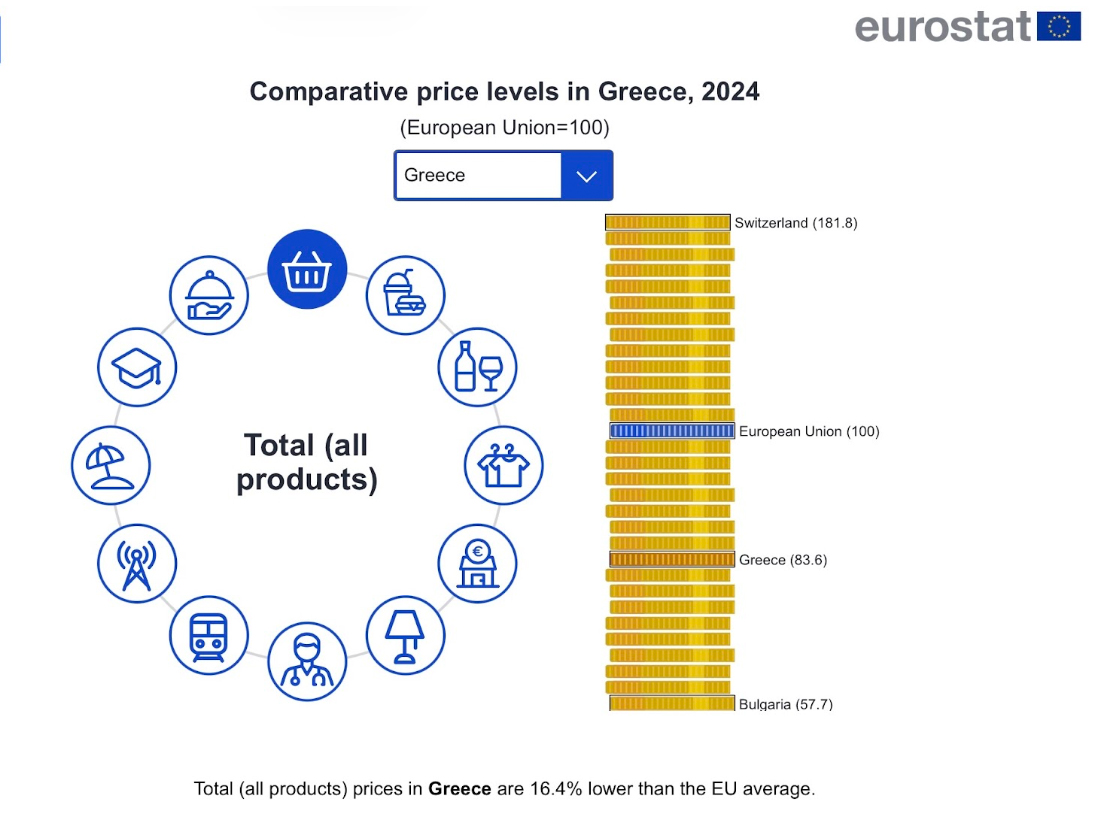
In practical terms, total monthly living costs in Greece are often 40-50% lower than in cities such as New York, San Francisco, Boston, or Los Angeles. Housing is the most significant differentiator: long-term rentals in central Athens or well-connected suburbs remain accessible even as demand rises, while utilities, groceries, and public transportation are priced far below U.S. norms.
Equally important is cost predictability. Inflation-adjusted living expenses in Greece remain more stable than in many U.S. cities, allowing expats to plan long-term budgets with fewer surprises which is an especially important factor for retirees and remote workers on fixed or foreign incomes.
| Athens | New York City | |
| Rent (2-bedroom apartment, city center) | $850 – $1,300 | $3,500 – $5,000 |
| Utilities (electricity, heating, water, garbage) | $100 – $150 | $200 – $350 |
| Internet & Mobile | $30 – $50 | $60 – $100 |
| Groceries (monthly, for 2 people) | $400 – $600 | $700 – $1,000 |
| Dining Out (2–3 meals/week) | $80 – $150 | $300 – $500 |
| Public Transportation | $45 – $60 | $132 (monthly Metro pass) |
| Health Insurance (private) | $50 – $150 | $400 – $800 |
| Car (gas, insurance, maintenance) | $150 – $250 | $300 – $500 |
| Total Monthly Costs (mid-range lifestyle, 2 people) | ~$1,600 – $2,500 | ~$5,400 – $7,500 |
Budget Breakdown: What $3,000/Month Gets You in Greece
A monthly budget of approximately $3,000 supports a comfortable, mid-range lifestyle in Greece for most singles and couples, and a reasonable standard of living for small families depending on location and housing choices.
At this level, Americans can typically expect:
- A centrally located one- or two-bedroom apartment in Athens or Thessaloniki, or a larger home in suburban or island locations
- Full utilities, high-speed internet, and mobile services
- Regular dining out, café culture, and entertainment
- Public transportation or modest car ownership
- Private health insurance coverage
For singles and couples, this budget often leaves room for travel, savings, or lifestyle upgrades such as frequent dining or weekend island trips. Families may need higher budgets if opting for larger properties or international schooling, but Greece remains significantly more affordable than equivalent U.S. living standards.
The key takeaway for most Americans is not just that Greece is cheaper, but that quality of life improves even as total monthly spending decreases.
Hidden Costs Americans Should Know About
While Greece offers substantial cost advantages, Americans should plan for several expenses that are less familiar or more front-loaded than in the U.S.:
- Property-related taxes and fees
Property owners pay annual ENFIA property tax, which varies by size, location, and property value. While modest by U.S. standards, it should be factored into ownership costs.
- Relocation and setup expenses
Initial costs such as rental deposits (usually two months), furnishing, utility connections, and administrative fees can add up during the first few months.
- Import duties and shipping costs
Shipping personal belongings from the U.S. can trigger customs duties and VAT, particularly for vehicles or high-value items. Many expats choose to downsize and purchase locally instead.
- Private education (if applicable)
International schools are widely available but can cost €7,000-€15,000+ per year per child, depending on curriculum and location.
Despite these considerations, most Americans find that once the initial transition phase is complete, ongoing living costs in Greece remain substantially lower and far more predictable than in the United States.
Reason #2: Remote Work Opportunities and Digital Nomad Visa
Greece has positioned itself as one of Europe’s most attractive destinations for American remote professionals by aligning lifestyle appeal with a clear legal framework for working from abroad. The introduction of the Greek Digital Nomad Visa has removed much of the uncertainty that previously surrounded long-term stays for U.S. remote workers.
The visa allows non-EU nationals to reside in Greece while earning income from employers or clients located outside the country. For Americans working in technology, consulting, finance, media, or other location-independent fields, this creates a lawful pathway to live in Greece without entering the local labor market.
Beyond the visa itself, Greece has invested heavily in digital infrastructure. Major cities such as Athens and Thessaloniki now offer widespread fiber-optic connectivity, modern coworking spaces, and a growing professional expat ecosystem. Many islands, including Crete, Corfu, and Rhodes have also upgraded connectivity, making year-round remote work feasible outside urban centers.
From a financial perspective, the program is further strengthened by tax incentives. Eligible applicants may benefit from a 50% reduction on Greek income tax for up to seven years, subject to individual circumstances and professional tax planning. Combined with Greece’s lower cost of living, this can materially improve net income for U.S. remote workers.
For Americans seeking flexibility, the Digital Nomad Visa provides:
- Legal long-term residence without local employment
- Access to Schengen travel while based in Greece
- A bridge to other residence options if long-term relocation becomes a priority
Required Documents for Digital Nomad Visa
Applicants must prepare a structured documentation file demonstrating income stability, legal compliance, and accommodation in Greece. While requirements may vary slightly by consulate, the core documents typically include:
- Valid passport or travel document recognised by Greek authorities
- Completed and signed long-stay national visa (Type D) application form
- Declaration letter confirming intent to work remotely for non-Greek entities
- Proof of employment or business activity (employment contract, client agreements, or company ownership documents)
- Proof of sufficient monthly income meeting the minimum threshold
- Proof of accommodation in Greece (rental agreement or property ownership)
- Comprehensive private health insurance valid in Greece
- Criminal record certificate issued by the applicant’s country of residence
- Medical certificate from a recognised public or private medical body
Once approved, the Digital Nomad Visa is typically issued for one year, with renewal options available if eligibility conditions continue to be met. For many Americans, it serves as a low-commitment entry point into living in Greece, often preceding longer-term residency or investment-based pathways.
Reason #3: Tax Benefits and Financial Incentives
Tax planning is a major driver behind the relocation decisions of many Americans, and Greece offers a surprisingly competitive framework when structured correctly. While U.S. citizens remain subject to U.S. worldwide taxation, Greece’s domestic tax regimes and bilateral treaty with the United States create meaningful opportunities to reduce overall tax exposure, particularly for retirees, remote professionals, and high-net-worth individuals with foreign income.
How Greece Taxes American Expats
Greece taxes individuals based on tax residency, which is generally established by spending 183 days or more per year in the country. Once considered a Greek tax resident, worldwide income is, in principle, taxable in Greece. However, several mitigating mechanisms apply to Americans.
- U.S.–Greece Double Taxation Treaty
The bilateral tax treaty between Greece and the United States prevents the same income from being taxed twice. In practice, this allows U.S. expats to offset Greek taxes paid against U.S. federal tax liabilities through foreign tax credits, reducing duplication.
- Progressive Greek Income Tax Rates
Greek-source income is taxed progressively, with current rates ranging from 9% to 44%, depending on income level. This applies to employment income, self-employment income generated in Greece, and Greek-source investment income.
Special Tax Regimes
- Certain categories of American expats may qualify for preferential regimes, such as:
- The Non-Dom regime, offering a flat tax on foreign income
- The 50% income tax reduction for eligible foreign professionals relocating to Greece
- The 7% pension tax regime for retirees
Each regime has distinct eligibility rules and should be evaluated with professional tax advice.
Retirement Income Tax Advantages
Greece has become especially attractive to American retirees due to its flat 7% tax regime on qualifying foreign pension income, available for up to 15 years.
Key features include:
- Applies to foreign pensions, including private pensions and certain retirement income streams
- Requires the applicant to transfer tax residency to Greece
- The applicant must not have been a Greek tax resident for 5 of the previous 6 years
- A physical presence of 183+ days per year is required
For many U.S. retirees, this results in a substantially lower effective tax rate compared to U.S. federal and state taxation, particularly when combined with treaty relief and foreign tax credits.
U.S. Social Security considerations
U.S. Social Security benefits may still be partially taxable in the United States. However, the tax treaty provides mechanisms to avoid double taxation, and in many cases, Greek tax exposure on these benefits is limited or offset.
Avoiding Double Taxation: What Americans Must Know
While Greece offers attractive tax conditions, U.S. citizens must remain compliant with U.S. reporting obligations regardless of where they live.
FBAR and FATCA Reporting
Americans must report:
- Foreign bank accounts exceeding $10,000 in aggregate (FBAR)
- Foreign financial assets above FATCA thresholds
- Failure to comply can result in significant penalties, making proper reporting essential.
Foreign Earned Income Exclusion (FEIE)
Eligible U.S. expats may exclude up to $120,000+ (indexed annually) of foreign-earned income from U.S. taxation if they meet the physical presence or bona fide residence tests. This can be combined with Greek taxation to reduce overall exposure.
Professional Cross-Border Planning
The interaction between Greek tax law and U.S. federal obligations is complex. Strategic use of:
- Foreign tax credits
- Treaty provisions
- Special Greek tax regimes
can significantly improve outcomes, but only when structured correctly. Most Americans relocating to Greece benefit from working with a U.S.–Greece cross-border tax advisor to ensure compliance while optimising their tax position.
Reason #4: Mediterranean Lifestyle and Health Benefits
Lifestyle is a major draw for Americans moving to Greece. The Mediterranean way of life with its fresh local food, regular physical activity, and strong social ties supports both physical and mental well-being.
- Health Advantages: Olive oil, seafood, vegetables, and whole grains promote longevity and lower cardiovascular risk. Nearby Blue Zones, like Ikaria, highlight these benefits.
- Active Lifestyle: Daily routines naturally include walking, cycling, and outdoor activity. Coastal areas provide swimming and hiking opportunities year-round.
- Work–Life Balance: Greek culture prioritises family, leisure, and social connection, helping residents reduce stress and improve overall quality of life.
Reason #5: High-Quality, Affordable Healthcare
Healthcare is a critical consideration for American expats, and this is one area where Greece compares very favorably to the United States. Greece offers high-quality and widely accessible private healthcare options that are significantly more affordable than U.S. healthcare, starting from €400, with English-speaking doctors.
Reason #6: Visa Options and Residency Pathways
Americans moving to Greece have multiple legal pathways to establish residency. The main options accommodate retirees, remote workers, investors, and families, providing flexibility depending on income, lifestyle, and long-term plans.
1. Financially Independent Person (FIP) Visa
Eligibility:
- Non-EU nationals with stable passive income (pensions, dividends, rental income, or savings) sufficient to support themselves without local employment.
Requirements:
- Proof of minimum monthly income (~€3,500 for single applicants)
- Valid private health insurance covering Greece
- Evidence of long-term accommodation (rental agreement or property ownership)
Benefits:
- Grants legal residence without the need to work locally
- Renewable residence permits
- Potential pathway to long-term or permanent residency
Required Documents
- Valid passport + 2-4 passport photos
- Proof of stable passive income or savings
- Proof of accommodation in Greece (rental agreement or property)
- Private health insurance valid in Greece
- Clean criminal record certificate
- Medical certificate (if required)
- Completed national Visa D application form
- Visa/residence permit fees
2. Golden Visa
Eligibility:
- Non-EU nationals, including U.S. citizens, making a qualifying investment in Greece under the Golden Visa program.
- Real estate is the most popular and practical investment route.
Investment Options:
- Real estate: Purchase property with a minimum value of €250,000, including certain commercial-to-residential conversions or heritage buildings.
- Alternative routes (less common): Capital contributions to Greek businesses, investment funds, government bonds, or bank deposits (higher thresholds).
Benefits:
- 5-year renewable residence permit for the investor and immediate family
- Visa-free travel across the Schengen Area
- No minimum stay requirement
- Clear 7-year path to Greek citizenship, subject to legal residency and language requirements
Astons focuses on real estate investment, offering curated Golden Visa-eligible properties and full support for purchase and residency.
Required Documents
- Valid international passport (all applicants)
- Four passport-size photos per applicant
- Proof of property investment
- Proof of legal entry
- Criminal record clearance from the country of residence
- Greek Tax Identification Number (TIN)
- Health insurance from a Greek provider for all applicants
- Marriage certificate (if applicable)
- Birth certificates (if applicable)
3. Tourist Visa
Eligibility:
- U.S. citizens for short stays in Greece (up to 90 days within a 180-day period).
Requirements:
- Valid U.S. passport
- Proof of onward travel (return ticket or onward journey)
- Sufficient funds to cover the stay
- No prior visa application required for stays up to 90 days
Benefits:
- Visa-free travel for up to 90 days within the Schengen Area
- Easy entry at border control
- Flexibility to explore Greece before committing to a long-term residency program
Best for:
- Americans visiting Greece for tourism, short-term business, or family visits prior to applying for a residency permit
Required Documents
- Valid passport
- Visa application form
- Two recent passport-size photos (per Schengen standards)
- Flight reservations (round-trip) and proof of accommodation in Greece
- Schengen-compliant health insurance coverage (€30,000 minimum)
- Proof of sufficient funds
- Cover letter explaining purpose of visit
Step-by-Step: Obtaining Greek Residency as an American
Obtaining residency involves careful preparation and documentation:
- Pre-arrival preparation: Research visa options, secure accommodation (rental or property purchase), gather proof of income or investment, and ensure health insurance coverage. For Golden Visa applicants, select a property that qualifies under program requirements.
- Required documents and translations: Typical documents include a valid passport, proof of income or investment, police clearance certificate, medical insurance, and rental or property ownership contracts. All documents must be officially translated into Greek and, in some cases, apostilled.
- Application submission process: Submit the application at the relevant Greek consulate or the Aliens & Immigration department in Greece.
- Timeline expectations: from 4 months.
Path to Permanent Residency and Citizenship
- Residency in Greece can eventually lead to permanent residency or citizenship, but certain requirements apply:
- Permanent residency: Typically requires 5 years of continuous residence in Greece. Golden Visa holders may need to demonstrate ongoing property ownership and legal compliance.
- Citizenship: Path to Greek citizenship generally takes 7 years of legal residence, including language, cultural, and integration requirements. Applicants must show sufficient knowledge of Greek language and culture and demonstrate integration into Greek society.
- Family inclusion: Spouses, parents, and dependent children can be included in the Greek Golden visa application, providing long-term security for American families relocating to Greece.
Reason #7: Geographic Advantages and Travel Opportunities
Greece as a European Base
Greece’s strategic location at the crossroads of Europe, the Middle East, and North Africa makes it an ideal hub for Americans seeking both business and leisure opportunities. Long-term residency allows U.S. citizens to stay beyond the 90-day Schengen limit, providing greater flexibility for travel, extended stays, and easier access to local services such as banking, rentals, and utilities.
Key geographic advantages include:
- Regional Connectivity: Direct flights from Athens and regional airports to major European, Middle Eastern, and North African cities.
- Short-Haul Travel: Low-cost carriers like Ryanair, Wizz Air, and Aegean Airlines facilitate affordable weekend trips across Europe.
- Proximity to Major Hubs: Easy access to Italy, Germany, France, Turkey, and beyond for business, tourism, or family visits.
Climate Benefits: Year-Round Sunshine
One of Greece’s most attractive features is its climate, which promotes an active, outdoor lifestyle.
- Abundant Sunlight: Many regions, especially the Aegean islands and southern mainland, enjoy over 300 sunny days annually.
- Mild Winters: Coastal areas rarely see temperatures below 5–10°C (41–50°F), while northern mainland regions are cooler but still moderate compared to northern U.S. winters.
- Diverse Climate Options: Americans can choose locations ranging from warm, sun-soaked islands to cooler, mountainous mainland areas, matching personal preferences for weather and lifestyle.
Real Challenges Americans Face When Moving to Greece
Bureaucracy and Administrative Hurdles
Navigating Greek bureaucracy is often cited as one of the primary challenges for Americans relocating. While procedures are well-defined, they can be time-consuming and require patience:
- Complex Processes: Applications for residence permits, tax registration, and healthcare often involve multiple visits to different offices.
- Document Requirements: Originals, certified translations, and sometimes apostilles are mandatory.
- Processing Delays: Even routine applications may take weeks to months, depending on local office workloads and completeness of documentation.
Cultural Adjustment Considerations
Adapting to Greek culture is essential for smooth integration and daily life:
- Language: While English is commonly spoken in tourist areas, learning Greek is crucial for interactions in administrative offices, neighborhoods, and schools.
- Business Practices: Meetings may start later than scheduled, decision-making can be informal, and networking often relies on personal relationships.
- Community Integration: Building social connections may take time, especially in smaller towns where residents value long-standing personal relationships.
Financial System Differences
Understanding the Greek financial system is critical for Americans to manage expenses and investments effectively:
- Banking for Non-EU Citizens: Opening accounts requires multiple proofs of address, tax numbers, and in-person verification. Some international transfers can take several days.
- Cash-Based Economy: Many local businesses still prefer cash transactions; digital payments are increasingly available but inconsistent outside major cities.
- International Money Transfers: Transferring funds from the U.S. may involve fees or delays, which must be factored into budgeting for recurring expenses such as rent, utilities, and healthcare.
How Astons Can Help Americans Move to Greece
Astons is a premier real estate and relocation consultancy in Greece, specialising in assisting U.S. citizens through every step of the relocation process. Our services are tailored for individuals seeking a seamless transition and a long-term lifestyle in Greece.
Property Search & Investment
Astons identifies Golden Visa‑eligible properties, including prime urban apartments, luxury villas, and reconstructed heritage buildings. We provide detailed market analysis, investment advice, and property inspections to ensure both compliance with residency requirements and potential for rental income or appreciation.
Golden Visa Application Support
Astons guides clients through the entire Golden Visa process: from pre-purchase due diligence to submitting applications to Greek authorities. This includes document verification, translation, tax registration, and coordination with local legal professionals, ensuring a smooth and efficient pathway to residency.
Settling In
- Beyond property acquisition, Astons helps Americans integrate into Greek life by assisting with:
- Banking and opening local accounts
- Health insurance registration and access to healthcare
- Utilities and telecommunication setup
- Legal compliance and administrative procedures
With Astons’ expertise, U.S. citizens can focus on enjoying Greece’s Mediterranean lifestyle while minimising bureaucratic hurdles and delays. Our hands-on approach ensures that relocation, property investment, and residency acquisition are executed professionally and efficiently.

Astons Community on social media


We’ll review your case and find the optimal path
In a 30-minute Consultation, We Will:
- Define a step-by-step process tailored to you
- Discuss the investment process and documentation
- Explain the risks and potential challenges in detail
- Initiate an internal assessment of your case’s success